
Atlantic Women
Hybrid feature film (doc/fic) - 90 min
Logline: Two women drifting in the Atlantic Ocean.
Sinopse: Atlantic Women addresses the issue of the diasporic condition from a female perspective. Alternating between real scenes and fiction, we follow the saga of two characters: a Brazilian and a South African who decide to reflect on their trajectories and investigate the process of becoming aware of what it means to be a black woman in a mixed-race society.
Texts on the screenwriting process:
Warning: this text, written in the form of a chronicle, does not aim to narrate facts about the creative process in chronological order. It consists more of an access to my fragmented memory, about facts that marked the process of writing my first feature film script, as a way of reflecting on the paths taken. I hope you enjoy this journey!
I decided to write about the paths I took during the creative process of this film in order to share, build bridges, and create dialogue for reflection on the screenwriting process, a topic that is so intense and profound for me.
Another factor that made me share was imagining that, in some way, I could contribute to the creative processes of other screenwriters, since there are no formulas for creation.
I find sharing enriching because it brings us insights, makes us realize mistakes and successes that we didn't notice before, and thus refine our work and grow stronger on this unique journey that is storytelling.
At the beginning of the process, being very Cartesian, I reflected a lot on writing methods and formats, not to follow them, but precisely to escape them. I think it is a common desire for those who write: to create unique stories that escape the norms of the audiovisual market. However, the more I reflected on the method, the more creative blocks arose.
In addition to often being stuck on the subject, with strong references to personal experiences, I was looking for a way, a device that would help me tell the story in an interesting way. Even though I was detached from formulas, I was unable not to follow them, since the need to communicate and be understood prevailed. I asked myself: will people understand this event as I perceive it? Am I being accurate in my approach? The search for answers was futile. Coupled with this was a huge crisis of insecurity, as a black woman who always loved writing but, like so many other black women, did not see herself as a screenwriter.
This marked my first journey into feature film screenwriting, guided entirely by empirical references, rooted in my own experiences and personal understanding. In other words, there was nothing based on Cartesian reason or Hollywood formulas, and that was a big challenge for me.
For us black women, especially those of my generation who grew up without many black references, without racial literacy in an extremely racist country, taking a stand is an act that generates a lot of insecurities, even if they are not so apparent to others. It took a lot of therapy and self-love to overcome this sea of insecurities and continue weaving this story.
That’s the reason why sharing is so important. By writing about this challenging process, I can lighten its weight, because many other people begin to carry it with me. Not to mention that sharing the experience helps other black women take other paths, with less rigidity towards themselves. And that also makes the experience lighter: thinking that I may be lightening the burden of another sister from the future, the past, or the present.
I began researching and sketching out certain facts about my career.
At the time, I was working in audiovisual production, in a sector so rigid and formal that I even forgot that, in a way, I was contributing to an artistic endeavor. I had a double life in the world of administration and executive production: my day was filled with spreadsheets, budgets, controls, payments, contracts, licenses, taxes, etc.
However, there were times when the directors (of the films I was working on) invited me to watch the first cut and give my opinion on the works. Those moments were magical.
Gradually, I realized that I had a lot of technical expertise, thanks to my graduation in radio and TV at UFPE and a lifetime of watching movies and series.
My involvement with films beyond production was so great that once, on an editing island, I was asked to make my own film. I was with a dear friend, closely following the completion of a short film, as executive producer, and my friend looked at me deeply and asked, “Dani, when are you going to direct your own movie?”
That question echoed in my mind for quite some time. Gradually, I realized that bureaucracy was no longer the right place for me. So I started writing my own project reflecting on cinema, the spaces we are granted in this audiovisual hierarchy, and that's how this project came about, in a very experimental way.
As I have always had a penchant for research and academia, the project seemed more like a scientific article than a creative proposal. To give you an idea, the title of this project was “Corpus Infinitum: Experiment No. 1.” Today, I see how contradictory this title is, divided between academic rigidity, which seeks to justify everything, and my search for a formula to express myself artistically, while the experiment allowed me to bring about some change and innovation.
As I went through my first creative workshop, the pieces began to fall into place: the evaluators asked for a lighter, simpler language, less academic, that would communicate with anyone who took the time to read the text. Then came the suggestion to change the title to “On this side of the Atlantic,” since I was reflecting on the consequences of the African diaspora here in Brazil.
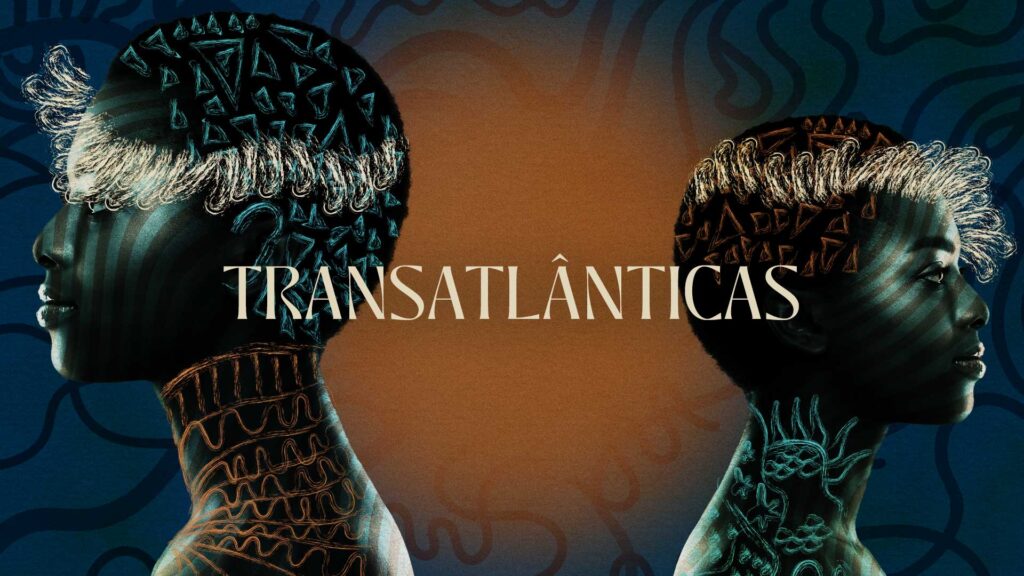
That title stayed with me for a long time, even though I didn't feel deeply that it was the ideal title. It's complex how we continue to follow things, people, projects, that don't touch us or fulfill us one hundred percent. It took me a long time to realize this reality, but I'm okay with it; I think that every work has its time to flourish, and that was the path mine took, until it arrived here, at the concept of “Transatlantic,” which perfectly defines the film's proposal to delve into the depths of two Black women who reflect on their trajectories and are separated by the same ocean that connects them: the Atlantic.
I then wanted to seek the definition of this space, which is not only physical and separates, but at the same time brings these two women closer together.
A. tlân.ti.co: adjective relating to the Atlantic Ocean or the states bathed by it, that is, the Atlantic coasts.
The reference to that ocean in the title of the work is because it has become the place of contact and circulation of people from the African, American, and European continents. The Atlantic is not only the place of contact between people, but also their baggage: their ideas, memories, values, traditions, languages, politics, cultures. All these characteristics of the peoples who transit under its waters are imprinted on it. The idea of the Atlantic, therefore, is directly linked to the diaspora of African peoples, since it was through this ocean that these peoples made (in)voluntary crossings.
So I thought about how to connect these characters, who were already intuitively aligned in their reflections before the sea. In an exercise of letting go, they accessed emotional memories and reflected on them, questioning their place in the world, in a racialized society. These women wanted to define the black female ethos, they wanted to answer the question: what is it like to be a black woman in Recife, Brazil? Or what is it like to be a black woman in Cape Town, South Africa?
Until then, reflections on the diaspora, especially in the audiovisual field, were made from the perspective of black men, but did not touch on women's issues of how to reconcile romantic and family relationships with artistic work. How to create a work of art while raising a child? How to create while belonging to a technical sector of the audiovisual field? This last question was so latent in my mind that I was overwhelmed by contractual obligations, taxes, fines, and deadlines for rendering accounts. It was—and still is—very costly to create under these conditions.
I felt so overwhelmed by the pressures of executive production that at the end of the day I was exhausted and had little motivation to research or write. Over time, I found encouragement in these moments of project development and managed to gather the strength to write from the heart, even when my mind and body were tired.
And so, with each step forward that the project took, I was Overjoyed, which made me feel that I was on the right track. This emotion began to guide me, to balance my time better, to dedicate myself more and more to the weaving of these projects, and thus, I obtained approval for a call for proposals for the development of a feature film script.
And so, with each step forward that the project took, I was Overjoyed, which made me feel that I was on the right track. This emotion began to guide me, to balance my time better, to dedicate myself more and more to the weaving of these projects, and thus, I obtained approval for a call for proposals for the development of a feature film script.
Dedicating time to writing and getting paid for it was a dream come true. So, I was able to do research, establish partnerships to read the texts and the project, connect with partner producers to develop it, find the ideal character on the other side of the Atlantic, and continue developing the story. And so, this project slowly but surely took shape and came to life.
I could finally see myself growing stronger along with the slow, but steady, construction of this piece of work that is just beginning.
The script is about to be completed and a new stage begins: that of production, of materializing a story that will certainly touch hearts. For in this long journey, I have understood that this is my role in this world: to tell stories that transform us. I look forward to your feedback, readers, to guide my journey!